
Bookkeeping and Accounting Terminology
Here is an explanation of some basic bookkeeping and accounting terminology, to help you to understand your business’ financials.
Balance Sheet
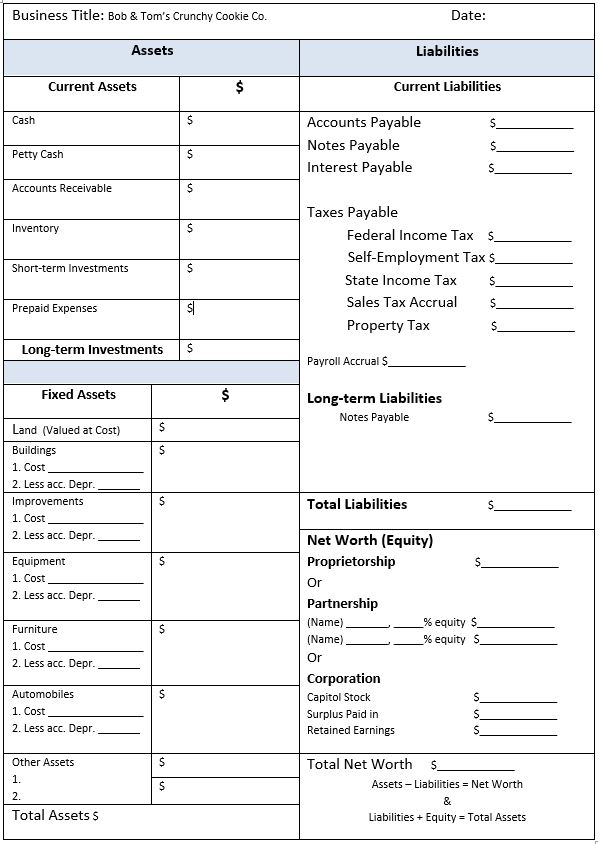
A balance sheet is a monetary statement that shows the assets, liabilities, and owner’s equity at a specific moment. Assets and liabilities are typically noted initially, followed by the equity which is the distinction between the assets and the liabilities. The balance sheet will eventually provide a snapshot of the business’s existing monetary condition.

Assets
Assets are possible future financial benefits acquired or managed by a particular entity as an outcome of past deals or occasions. Anything that has a financial value and can be owned or managed to produce worth has the prospective to produce such future financial benefits. Whether concrete or intangible, ownership of any form of value such as cash money or stock is considered to be an asset.

Liabilities
Probable future sacrifices of earnings or assets, emerging from present obligation to a particular entity. If liabilities are settled, they might end up being moved assets or supply services to other entities in the future as a result of previous transactions or events. A liability is a responsibility or duty to another in return for some type of debt such as a company loan which would involve the settlement of that loan.

Equity
Ownership in assets after all financial obligations owed for that asset has been settled. Assets such as stock and own a home can be thought about equity if no involved financial obligations stay. Once a house or car is settled, the possession is now the owner’s equity. Equity is any asset that can be sold for financial gain without any attached debts being owed. The owner must gain 100% of the revenue from the sale of an asset if that property is his/her own equity.

Revenue
The charge paid to a lending institution for a loan, or all transactions for which monies are gotten. It can be the earnings from products and services offered and making use of financial investments. Revenue can likewise be a transaction and the resulting income for which cash are gotten, nevertheless, loan funds and equity deposits are ruled out revenue.

Cost of Goods Sold
The expense of producing products that are delivered to consumers to produce revenue or the expense of inventory offered during an accounting period. This includes the expense of purchases made during a stock duration minus the ending inventory for that period. This term is typically shortened as COGS.

Expenses
Expenses are the expense of producing revenue through the sale of products or services. They can be found in many types such as incomes or earnings, and devaluation of assets. An expense can be nearly anything that is sustained when working.

Accounting Period
The Accounting period is the quantity of time in which earnings declarations and other financial statements are used to track and report operating results. In New Zealand, they generally run for twelve months between April and March, however an accounting period can begin and end anytime depending upon business needs or wants.
Bookkeeping and Accounting Terminology - Summary so far
You must now be familiar with some general Bookkeeping and Accounting Terminology most often used for organizations. Keep in mind:
- A balance sheet is a financial declaration that reveals the assets, liabilities, and owner’s equity at a specific point in time.
- Whether concrete or intangible, ownership of any form of value such as money or stock is considered an asset.
- Liabilities are possible future sacrifices of income or assets, emerging from present commitment to a particular entity.
- Equity can be ownership in assets after all debts owed for that property have been paid off.
- An income statement includes a summary of how a company normally sustains its earnings and expenses over a financial quarter or year.
- Revenue can be a deal and the resulting earnings for which cash are gotten.
- Cost of Goods Sold is the expense of purchases made during an inventory period minus the ending stock for that duration.
- Expenses are the expense of producing revenue through the sale of products or services.
- An accounting period is a time period in which income statements and other financial declarations are used to track and report operating outcomes.
More Bookkeeping and Accounting Terminology
Accounts Receivable
This type of record is used to track money that is owed to a service. Such money can originate from extending credit to a customer who purchases the businesses service or products. The very best way to keep an eye on these figures is to set up a different accounts receivable record for each customer.
Accounts Payable
This type of record is utilized to track debts owed by an organization to lenders for purchased goods or services. Though a business will likely be billed frequently by its financial institutions for the balance on the account, having its own records will enable the business to be aware of their financial standing with creditors at any given time.
Depreciation
Includes both the decline in worth of possessions, typically due to unfavourable market conditions, along with the allotment of the expenses of tangible properties over their useful lifetime to the durations in which the possessions are really utilized. The decline in worth will have an impact on the worth of service and entities while the allotment of expense impacts net income.
General Ledger
In double-entry accounting, these are forms utilized for the accounts on different sheets, in a book or binder, and are called the general ledger. This is thought to be a permanent, classified record for each company account.
Interest
Interest is a sort of settlement to a lender for taking a risk of principal loss when cash or another possession is lent. When money is obtained, the borrower typically pays a portion of the total quantity owed also known as the principal, as a fee, in addition to a particular quantity of the initial balance for each billing period. It is a sum quantity charged for loaning.
Inventory
Inventory can be described as either a list of products and materials or the products and materials themselves. It is thought of as a possession and usually refers to materials kept in stock by a business. Inventory is among the most important possessions that an organization possesses since they are all set or will be prepared to be offered thus; inventory is typically a main source for income.
Journals
A journal is used to record the financial transactions made by a service. Whether the transactions are credits or debits, they should be input into a journal at the time and date which they occur. These recordings can then be used for future referral and reconciling and can be moved to other main records such as the general ledger. All journal entries need to include the deal date, type, and amount.
Payroll
Payroll can refer to either the total amount in compensation that a company owes to its workers for a set period of time, or the actual list of staff members business should pay together with the amount owed. It is typically a major expenditure for organizations however will likely differ from time to time depending on the business’ requirement of its workers at the time, among other things.
Trial Balance
A worksheet typically prepared at the end of each recording period. The balances of all journals are put into 2 columns labelled “debits” and “credits”. This worksheet helps to guarantee that all mathematical data used in the business’ accounting system is right. If the total debits are in reality equivalent to the total credits, the trial balance is well balanced. This worksheet method is likewise described as a T-Account due to the shape the information handles with the two column format
Bookkeeping and Accounting Terminology - Summary 2
You now recognize a few accounting documents frequently used for services in addition to terms which can define the health of a business.
Keep in mind:
- Accounts receivable are those records which monitor money owed to a business or cash received.
- Accounts payable involves records which keep track of money owed by the service or cash paid.
- Depreciation most often refers to the decline in value of assets but may likewise describe the allowance of the expenses of tangible properties over their beneficial lifetime.
- The general ledger is used to keep long-term, classified record of company accounts.
- Interest is a form of settlement owed to a lending institution from the borrower for allowing them to borrow.
- Inventory can be either a list of items and products of an organization or the goods and materials themselves.
- A journal is utilized to record the monetary transactions made by a company, whether they are credits or debits.
- Payroll can be either the overall amount in pay a business owes to its staff members of the real list of staff members business will pay.
- And finally, a trial balance is utilized to record the balance of all ledgers, normally in the format of 2 columns identified “debits” and “credits”, called the T-Account format.
Accounting Methods
Cash Method
This means that you will record the money once you receive it. The receipts for such transactions are recorded during the periods they are received. An example of this method is when you are making a cash deposit in the bank and they record it into your account as receiving cash. If you present the teller with a check, then she would not be able to document it as cash. If the teller does not record the cash as she receives it, she would not be able to properly account for the cash later.
Accrual Method
Accrual is the method of accounting in which all income and expenses are recognised on the income statement at the time when they are earned and incurred, regardless of when the cash for that transaction is received or paid. An example of this method would be, when you work, your hours are documented, and although you are earning a salary, you won’t receive the money you have accumulated until you get a pay check, and it is cashed. The accounting department still has to recognise that those funds are going to be paid in the future.
Differences between Cash and Accrual
The differences between the two are that the cash method is recorded when you receive the actual cash whereas with the accrual method, you will record it even if you have not received it or paid for it. For example, you are selling candy bars for your child’s school, when you receive the cash; you mark it down in the paid section. This is considered the cash method. If you were using the accrual method, you would want to record the transaction with anticipation of receiving the funds at a later date. This method will help you keep track of anticipated funds so that you can better manage your business. With the cash method, you receive the revenue at the time of the transaction like when you go into a store and purchase something vs. putting something on a “pay later” plan.
Need help?
 Perhaps someone in your company needs help with understanding bookkeeping? As CEO, it is in your best interests to ensure you have someone knowledgeable to manage your books.
If you would like to discuss how this, and other topics essential to managing your company, can be taught to your staff, get in touch. We can discuss how a New Zealand business coach can help.
